
Rendering died first
I know talking about 'Rendering died...' might sound like aggressive clickbait. And in part it is: it's a necessary provocation to bring a debate to the table that goes far beyond a specific tool.
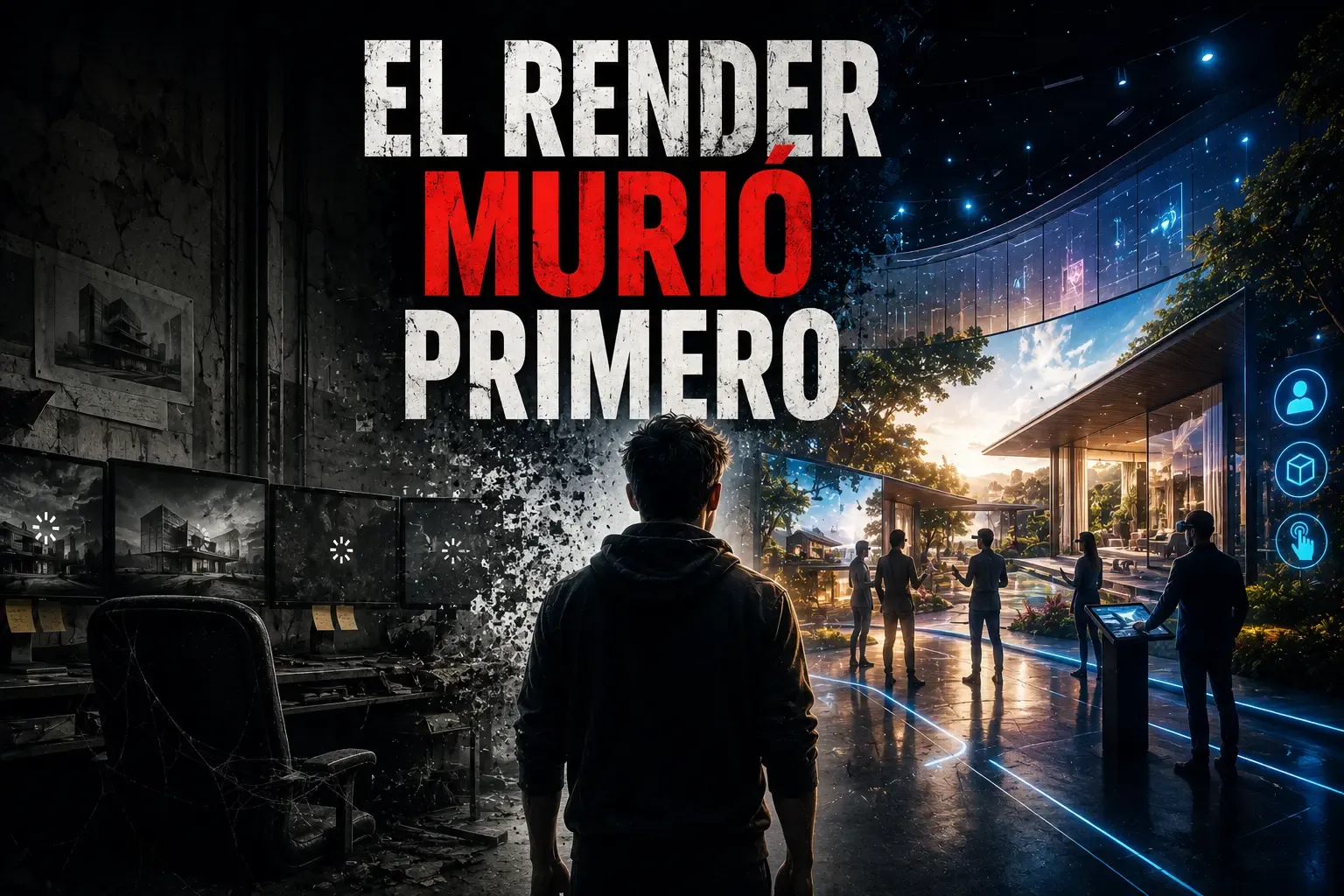
I don't usually write much about these topics, but I've been seeing something quite clearly for months.
AI is not only changing how we work. It's changing what kind of professionals will continue to have value.
And honestly, I think many creative sectors are still not aware of how fast it's happening.
I know talking about the "end of the 3D artist" might sound like aggressive clickbait. And in part it is: it's a necessary provocation to bring a debate to the table that goes far beyond a specific tool. Throughout this article, I want to explain why, although the title is blunt, the reality behind it is a systemic challenge that forces us to redefine our value.
The Problem Didn't Start with AI
I've been working in 3D visualization for years, using Unreal Engine daily and developing interactive experiences. I've even given courses and classes as an instructor.
For a long time, I thought —like many people— that the next logical step for ArchViz would be real interactive experiences.
Explorable spaces. Configurators. Visual storytelling. Real-time. Interaction.
Technically, it made perfect sense. But reality was different.
Most of the market never really ended up demanding that complexity. Even large clients continued to prioritize quick renders, attractive videos, and immediate results.
And that's where AI has simply accelerated something that was already happening.
Automation is Entering All Sectors
This no longer just affects ArchViz.
The entire audiovisual market is entering a massive war: post-production, creative agencies, advertising, motion graphics, photography, video…
Everyone is trying to understand where human value remains when more and more processes can be automated.
Every few months, new tools appear that aggressively reduce production times, teams, and costs.
What a few years ago required entire departments can now be done by a single person with good tools and technical judgment.
And that completely changes the rules of the market.
The Systemic Challenge: Beyond Unreal Engine Limitations
There's also something interesting here that I think is rarely discussed.
Unreal Engine remains incredibly powerful for real-time and visualization, but its architecture is starting to show certain limitations in the face of the new AI paradigm.
Blueprints are fantastic for prototyping and creating visual logic quickly. But when you try to integrate APIs, AI models, agents, external systems, or complex workflows, many frictions begin to appear.
Meanwhile, Unity is already showing quite clearly where it wants to go with Unity AI: workflow automation, logic assistance, asset generation…
And honestly, I hope Unreal manages to adapt well because the change is being extremely fast.
Real Value is Starting to Be in the Experience
In recent months, working on developing dynamics for events and interactive experiences, I've realized something important:
Value is no longer just in generating images.
It's in designing experiences that depend on you.
Systems designed specifically for how the user will interact. Experiences created for a specific event. Real-time interaction. Screens that react. Immersive spaces. Flows designed to generate participation.
That's where the human component becomes important again.
Because you are not just generating content. You are designing behavior, interaction, and experience.
And that is much harder to replace.
AI Also Opens Up Huge Opportunities
The interesting part is that AI doesn't just destroy processes.
It's also allowing the creation of things that just a few years ago were economically unfeasible for small teams or freelancers.
Now, a single person can develop systems and experiences that previously required massive structures.
And I think there's a brutal opportunity there for hybrid profiles: technical and creative people capable of connecting development, design, and interaction.
The problem is that this will also force us to be much more competitive.
The Necessary Evolution: From Visualizer to Hybrid Profile
I sincerely believe that the classic profile of "3D artist" or "visualizer" is entering a complicated point if it doesn't evolve towards something more hybrid.
Because competing solely on producing images will become increasingly difficult.
The barrier to entry is falling very fast.
And there will also be another problem: many clients still don't understand the real value of customized experiences, interaction, or bespoke developments compared to automatically generated solutions.
That's why I believe the future is not just about generating better images.
It's about creating experiences that people want to live.
And above all, experiences where you remain an important part of the value.